
How to Search Isabella County Court Records
The main online route runs through Michigan's statewide case search, called MiCOURT. One entry point serves the whole state, and three court codes cover Isabella County. The 21st Circuit Court uses code C21, the 76th District Court uses D76, and the 37th Probate Court uses P37. All three sit in the Isabella County Trial Court complex in Mount Pleasant. The portal returns case-level results, not full document images.
Before you start, know the party name or the case number. A birth year helps narrow a common name. The portal opens with a terms notice that you must accept, and then it asks you to pick a court. Name search, case number search, and professional number search each get their own tab.
- Open the MiCOURT case search and accept the terms of use notice.
- Choose the Isabella County court that fits your case: Circuit (C21), District (D76), or Probate (P37).
- Pick a search mode, then enter a last name and first name, or a case number.
- Add filters such as birth year or a filed-date range to trim the results.
- Open a matching row to view the case status, next hearing, and party details.
The judiciary also publishes a court directory feed that lists every searchable court code. The lead-in for that behind-the-scenes list sits at the MiCOURT court metadata endpoint, which confirms how Isabella County maps to C21, D76, and P37.
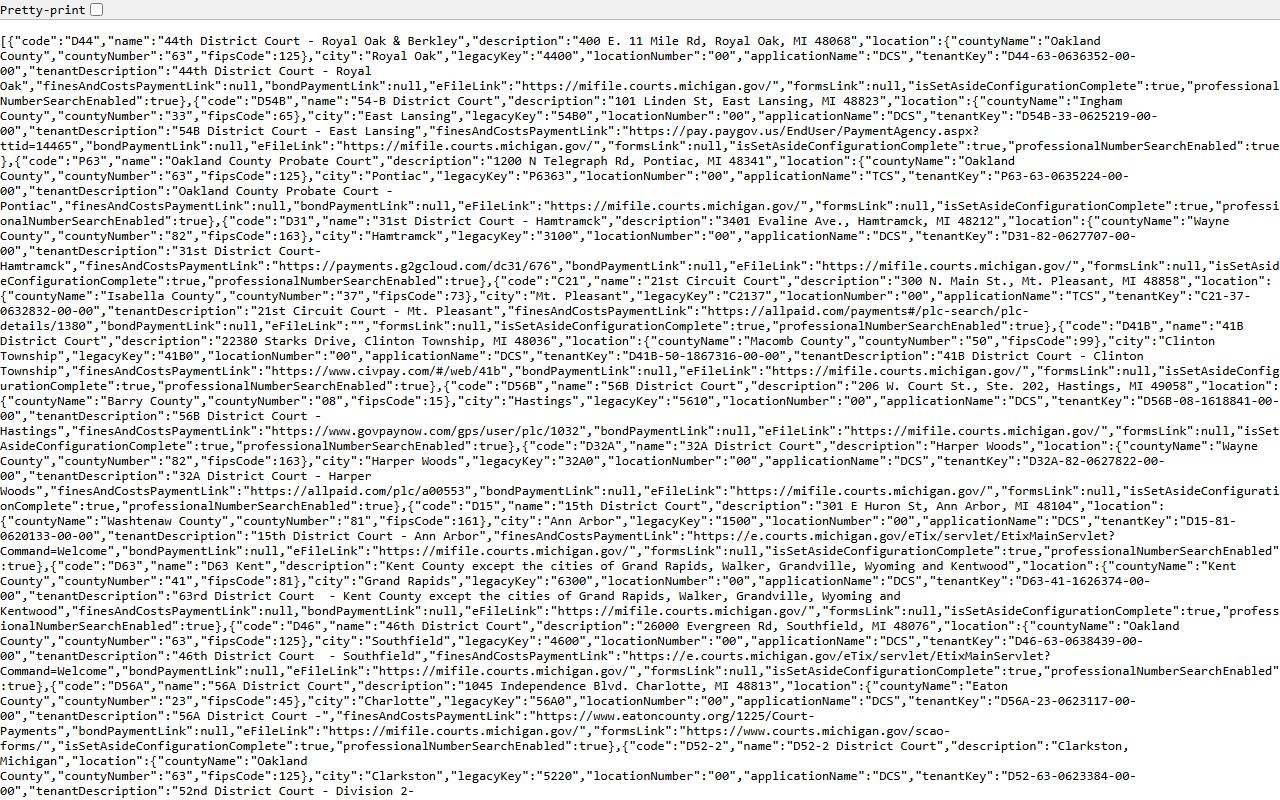
That endpoint shows why picking the right code matters: each court holds a different slice of the county's Isabella County court records, and choosing the wrong one returns an empty result.
Isabella County Court Records Search Fields
The search form mixes required and optional fields. In name mode, the last name drives the query. In case mode, the case number does. The rest of the fields act as filters that narrow a long result list. The table below maps the fields observed on the MiCOURT search form.
| Field Label | Type | Required | Notes / Format |
|---|---|---|---|
| Last Name or Business | Text | Yes (name mode) | Accepts a party or business name |
| First Name | Text | No | Optional supporting filter |
| Middle Name | Text | No | Optional |
| Birth Year | Text | No | Helps filter a common name |
| Filed From / Filed To | Date | No | Filing date range |
| Offense From / Offense To | Date | No | Offense date range |
| Case Type / Status | Checkbox | No | Open, adjudicated, closed, civil, criminal-traffic, probate, juvenile |
| Case Number | Text | Yes (case mode) | Format varies by court and year |
| Attorney / Professional Number | Text | Conditional | Used in professional-number mode |
Not every category shows up in the public view. Sensitive matters like adoptions, name changes, and juvenile files may be blocked from open search, so a blank result does not always mean a case does not exist.
Types of Isabella County Court Records
The county trial courts split work by case type. Adult misdemeanors, civil infractions, and small claims start in the 76th District Court. Felonies, larger civil claims, and family matters sit in the 21st Circuit Court. Estates, guardianships, and adoptions run through the 37th Probate Court. Small claims cap at $7,000, District civil claims cap at $25,000, and anything above that threshold moves to the Circuit Court.
Some records live outside the case portal. Marriage records stay with the County Clerk, traffic tickets flow through the state eTix system, and jail booking data belongs to the sheriff. The list below groups the main record types you can trace back to an Isabella County court or office.
- Criminal case records, including complaints, arraignment data, bond events, and charge progression.
- Civil and small claims records, including landlord-tenant disputes and land contract forfeiture.
- Family records tied to divorce, custody, paternity, and Friend of the Court support enforcement.
- Probate filings for estates, conservatorships, guardianships, name changes, and adoptions.
- Traffic and civil-infraction citations adjudicated in District Court and searchable through eTix.
The 76th District Court explains its civil and small claims intake in detail, and the county civil and small claims page lays out the dollar thresholds and referral rules.
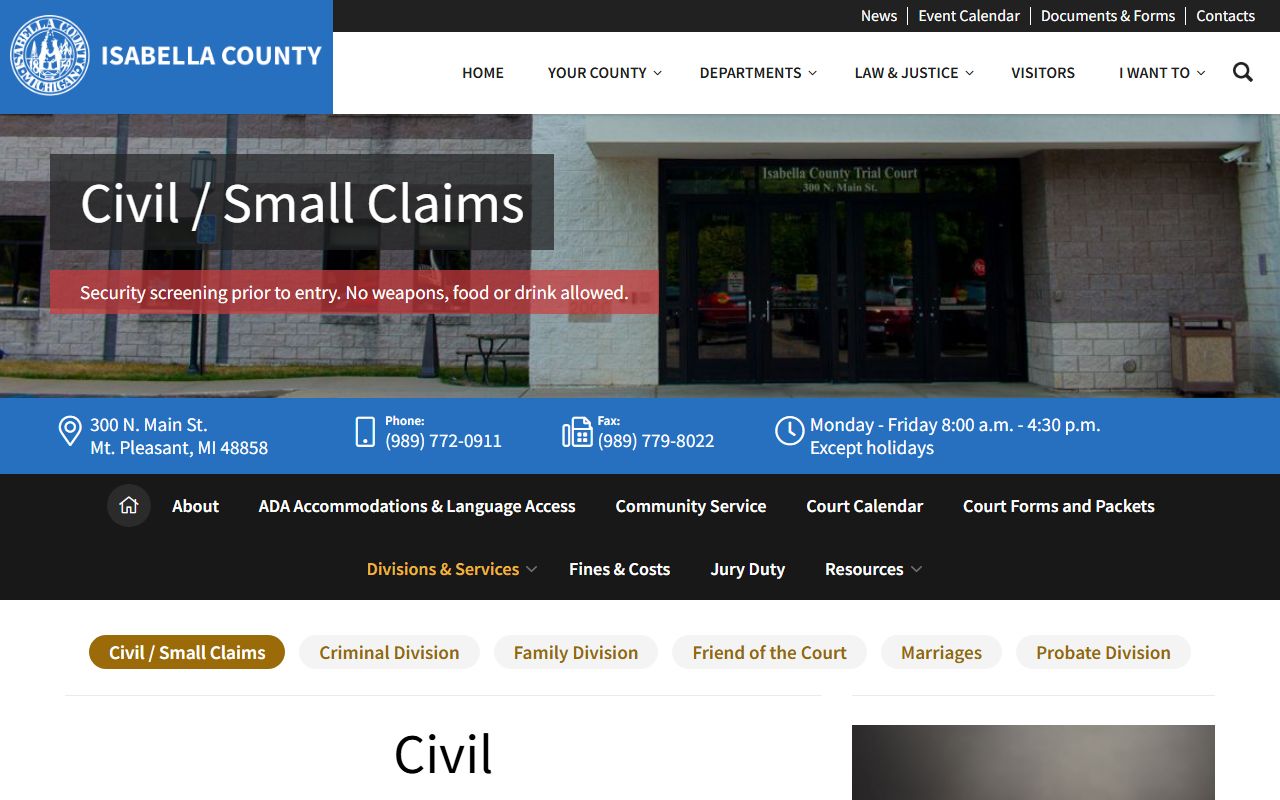
That page helps you decide whether a dispute belongs in the District Court small claims track or the Circuit Court, which in turn tells you which Isabella County court records to search.
What Isabella County Court Records Show
A MiCOURT result row carries case-level metadata, not the full paper file. It confirms that a case exists, names the parties, and reports where the case stands. Deeper items such as motions, orders, and document images usually require a clerk request or an in-person visit. The table maps the fields a single search row returns.
| Field | What It Shows |
|---|---|
| Case Number | The unique case identifier assigned by the court |
| Case Title | The party names, such as the plaintiff and defendant |
| Filed Date | The date the case opened with the court |
| Case Status | Open, pending, adjudicated, disposed, or closed |
| Court | The Circuit, District, or Probate court that holds the case |
| Next Hearing | The next scheduled court date, when one is set |
| Party Type | The role of the named person, such as defendant or petitioner |
| Year of Birth | A person filter used to separate similar names |
| Balance / Costs | Any fees or fines still owed on the case |
The status labels can confuse first-time users, so it helps to know the common terms before you read a result. The short glossary below defines the words that show up most often in an Isabella County court records search.
- Open or Pending
- The case is still active and has not reached a final ruling.
- Adjudicated or Disposed
- The court has decided the matter, though follow-up steps may remain.
- Closed
- The case is finished and no further action is scheduled.
- Party Type
- The role a named person plays, such as plaintiff, defendant, or petitioner.
Document links and full docket images do not appear at the list level. When the online row leaves out a detail you need, the clerk holds the fuller file, and the Isabella County court dockets page explains how the event log fits alongside the case metadata.
Public Access Framework for Isabella County Court Records
Michigan treats most court files as open to the public. The Freedom of Information Act at MCL 15.231 sets the baseline duty to disclose public records, while the exemption list at MCL 15.243 carves out records that stay closed. A separate provision at MCL 15.443 addresses enhanced public-record access. Court files carry their own layer of rules on top of FOIA.
The judiciary governs case files through the Michigan Court Rules, and MCR 8.119 defines what counts as a public court record and how clerks must maintain it. The same rule set requires clerks to redact personal identifiers before releasing a file. Anyone may view an open case, though a request for copies can carry a fee and may need identity details for certified copies.
Note: A public status does not promise instant full disclosure, since a clerk may still redact personal identifiers or withhold a protected portion of an otherwise open file.
Records That Are Sealed or Confidential in Isabella County
Some case types never reach the public search view. Juvenile filings carry statutory confidentiality under the juvenile code, and the disclosure limits at MCL 712A.18e shield many youth records. Adoption files, mental-health hospitalization petitions, and certain family-support records also stay restricted. Local administrative orders on records access guide how the trial court applies these limits day to day.
A conviction that has been set aside drops out of public view under the expungement framework at MCL 780.621 and its related sections. To view a sealed or restricted file, a party or attorney generally files a motion with the court that holds the record, or submits a formal records request through the clerk. The court then decides whether the requester has a legal basis for access.
Requesting Records Beyond the Online Database
The online portal is a starting point, not the whole record system. When a file is old, sealed in part, or missing a document you need, the County Clerk handles criminal, civil, and Circuit Court record requests. A phone call or a written request can surface material the public search never shows. For deeds, liens, and property-related filings, the Register of Deeds keeps a separate index that court users often need alongside a civil case.
The county's land record search portal covers recorded property documents that sit outside the court case system.
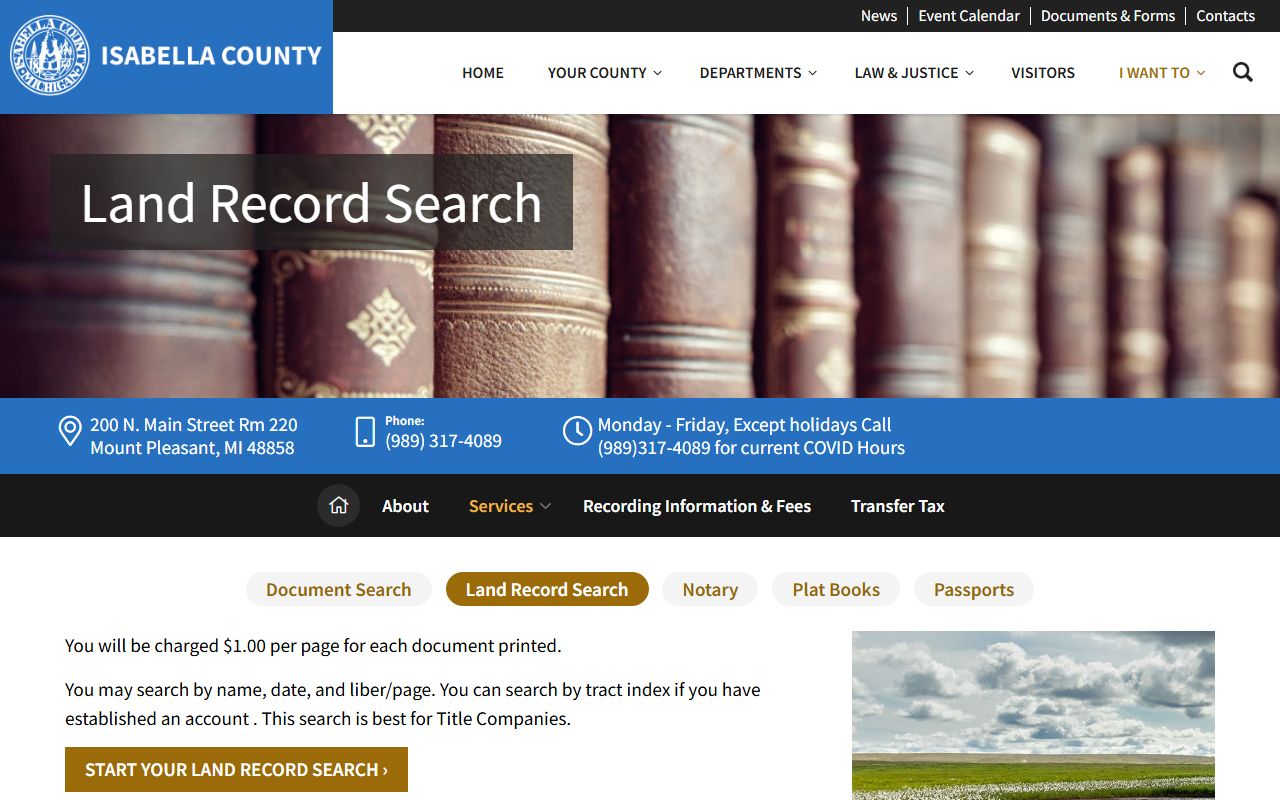
Pairing a land record search with an Isabella County court records lookup helps when a civil dispute touches a mortgage, a lien, or a boundary claim. The fallback order is simple: try MiCOURT first, then the clerk, then an in-person visit for the full file.
In-Person Court Record Requests
Some records are easiest to get at the counter. The County Clerk keeps criminal, civil, and Circuit Court records at its Mount Pleasant office and can print certified copies for legal use. Bring the case number if you have it, along with a photo ID for certified requests. Court filings themselves route to the trial court building at 300 North Main Street, while the clerk's public counter sits a short distance away in downtown Mount Pleasant.
Isabella County Clerk
207 North Court St.
Mount Pleasant, MI 48858
(989) 317-4070
Mon-Fri 8:00 a.m. to 4:30 p.m.
Downtown Mount Pleasant sits near the Chippewa River, and the county's visitor page gives general bearings for anyone driving in for a records visit.
Plan for business-hours operation and security screening at the courthouse, since weapons, food, and drink are not allowed inside the building that holds many Isabella County court records.