
Criminal Court Records in Isabella County
A criminal court record is the official case file a court keeps after formal charges are filed against a person. In Isabella County the file opens when the prosecutor brings a charge and the clerk assigns a case number. It holds the charges as filed, the arraignment, every plea, motion, and hearing, and the final disposition and sentence. The County Clerk acts as clerk of the Circuit Court and keeps these files for public reference. A single case can run for months, and the record grows with each event.
Adult criminal cases move through two trial courts housed in the same Mount Pleasant complex. The 76th District Court handles misdemeanors and opens every adult felony with the first appearance, arraignment, warrants, and bond. The 21st Circuit Court takes felony cases after a defendant is bound over for trial. Each court keeps the part of the record it produces, so a serious case can leave a trail in both. A closer look at the individual counts appears in the Isabella County arrest records and court charges.
The county Trial Court describes how its criminal division processes cases from filing through sentencing.
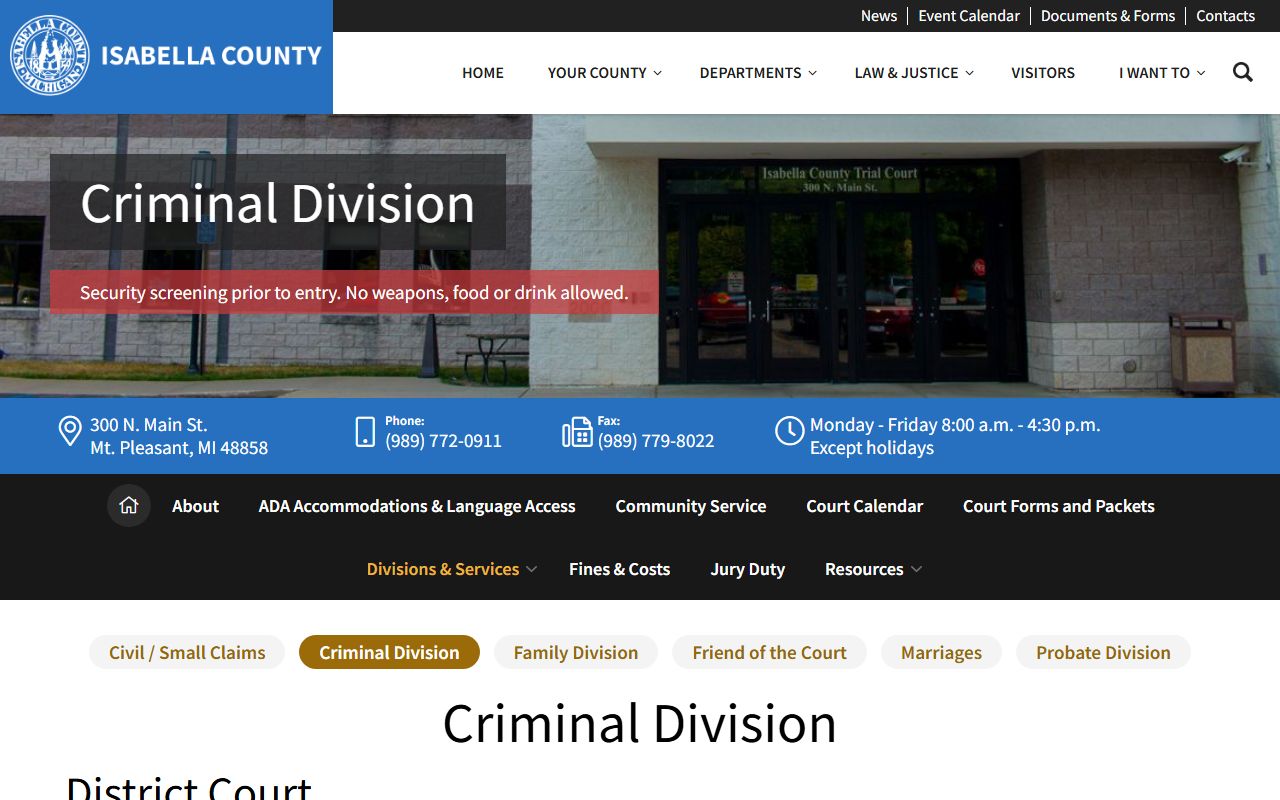
That division page confirms where felony and misdemeanor files begin and which office to contact when a record is not visible online.
How to Search Isabella County Criminal Court Records
The main public tool is MiCOURT, the Michigan judiciary case search. It reaches each local court by code: the 21st Circuit Court, the 76th District Court, and the 37th Probate Court. A search returns case-level details such as the case number, party names, filing date, status, and the next hearing. Full documents and images are not shown in the result list, so a deeper record often needs a clerk request.
- Open the MiCOURT case search and accept the usage terms.
- Search by defendant name, or enter a case number if you have one.
- Pick the right court, then narrow by case type and filing or offense date.
- Open the case to read the docket, charges, and disposition.
- Request a certified copy from the County Clerk when the online view stops short.
Isabella County felony filings sit in the 21st Circuit Court search, while misdemeanors and criminal-traffic matters usually appear in the 76th District Court search. For a statewide picture of who is under supervision, the Michigan Department of Corrections runs the OTIS offender search. Broader case types beyond criminal matters sit in the county court records.
The circuit search interface shows how a defendant lookup is built for local felony files.
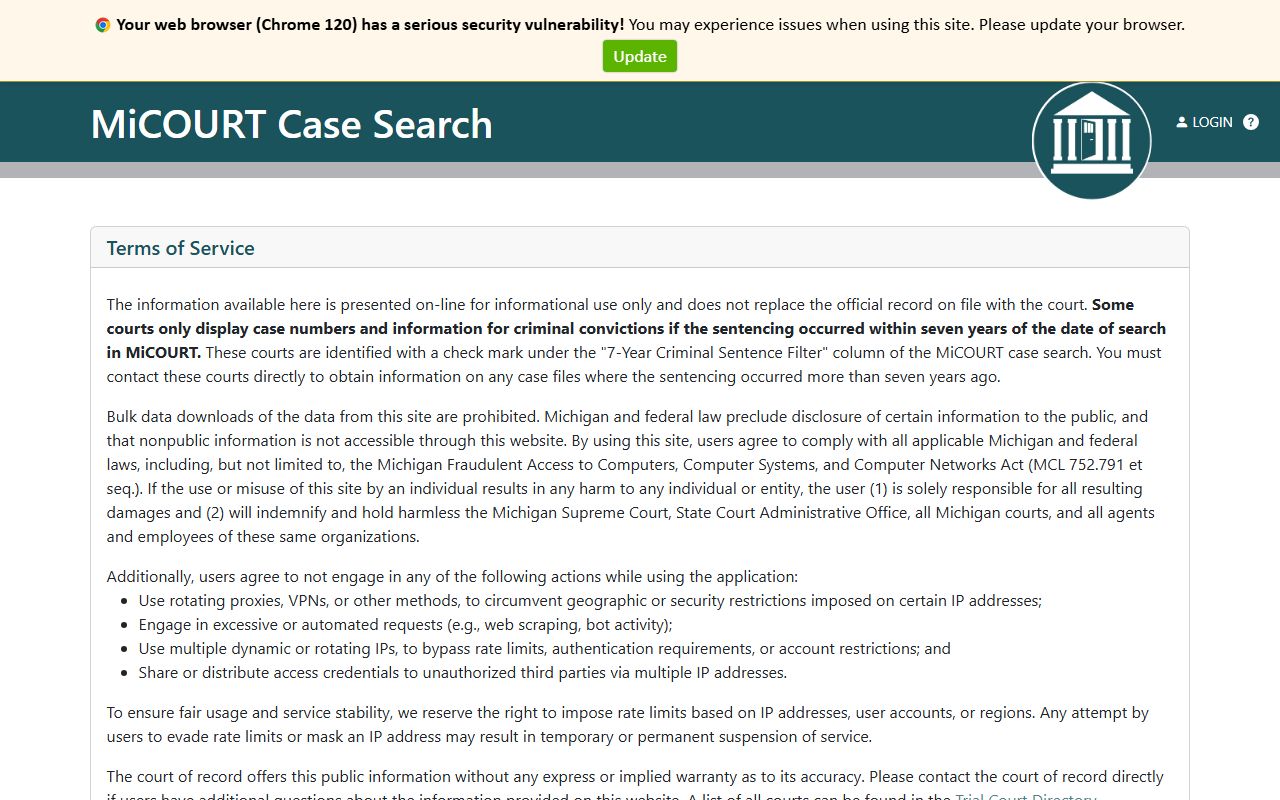
Each result row links back to a single case, which is the entry point for reading the full criminal court record.
Stages of an Isabella County Criminal Case
A criminal case moves in a set order, and the record marks each step. The prosecutor, Mark Kowalczyk, opens the matter by filing charges. The 76th District Court holds the first hearing. A felony can then move up to the 21st Circuit Court. At arraignment a defendant may be represented by the county Public Defender, an office set up in 2019 to cover early appearances. Every event adds a dated entry to the file.
Case flow: Charges Filed › Arraignment › Pretrial / Motions › Plea or Trial › Disposition › Sentencing
| Stage | What Happens |
|---|---|
| Arraignment | The court reads the charges, sets or reviews bond, and takes a first plea. |
| Pretrial / Motions | Both sides trade evidence and file motions; charges may be amended or reduced. |
| Plea or Trial | The defendant enters a plea, or a judge or jury hears the case and reaches a verdict. |
| Sentencing | After a guilty finding the judge orders jail, probation, fines, or other terms. |
Note: A felony that starts in the District Court and moves to Circuit Court leaves entries in both court files, so check each one.
What an Isabella County Criminal Court Record Shows
A criminal court record is more than a name and a charge. It ties together the parties, the counts, the dates, and the outcome in one running file. The public search view shows the top-level fields. The full docket, held by the clerk, adds motions, orders, hearing notes, and any fines or costs. The fields below appear across most Michigan criminal files.
| Field | What It Shows |
|---|---|
| Case Number | The unique ID tied to the court and filing year. |
| Defendant | The charged person's name and year of birth. |
| Charges | Each count as filed, with its statute cite and severity level. |
| Plea | How the defendant answered: guilty, not guilty, or no contest. |
| Hearings | Past events and the next scheduled court date. |
| Disposition | The result of each count, such as convicted, dismissed, or acquitted. |
| Sentence | The penalty imposed: jail, probation, fines, or other terms. |
Charges vs. Convictions
Being charged is not the same as being convicted. A charge is an accusation that the case is only beginning to test. A criminal court record can show counts that were later dropped, dismissed, or that ended in an acquittal. Reading the disposition for each count, not just the charge line, is the only way to know the real result. Many files show a charge reduced or set aside before the case closed.
| Charge | Conviction | |
|---|---|---|
| Stage | Accusation | Verdict or plea |
| Burden of Proof | Probable cause | Beyond reasonable doubt |
| Public Record | Yes | Yes |
Reading Dispositions and Sentences
The disposition is the line that tells you how a count ended. Common terms include guilty, not guilty, dismissed, and nolo contendere, which is a no-contest plea. Some files show a deferred or delayed sentence, where a judge holds the outcome open while the defendant meets set terms. The sentence follows the disposition and lists jail time, probation, fines, and costs. Read both lines together, because a guilty plea to a lesser count often replaces the original charge.
When the online docket stops short of the full file, the County Clerk's criminal and civil records service can supply certified copies.
A certified copy carries the clerk's seal and is the version courts and agencies accept as official.
Sealed vs. Expunged Records
Sealing and expungement both limit who can see a record, but they are not the same. A sealed file stays in existence and is hidden from routine public view, while an order still lets some agencies reach it. An expunged, or set aside, conviction is treated as though it never happened, and the public record is removed. Michigan sets its own path for this relief under statute, with waiting periods that depend on the offense.
| Sealed | Expunged | |
|---|---|---|
| Visibility | Hidden from public | Set aside and treated as never existed |
| Law Enforcement | Limited access | Very limited |
| Eligibility | By court order in protected cases | Set by Michigan expungement law and waiting periods |
The state expungement rules for adults are laid out in the Michigan expungement statute.
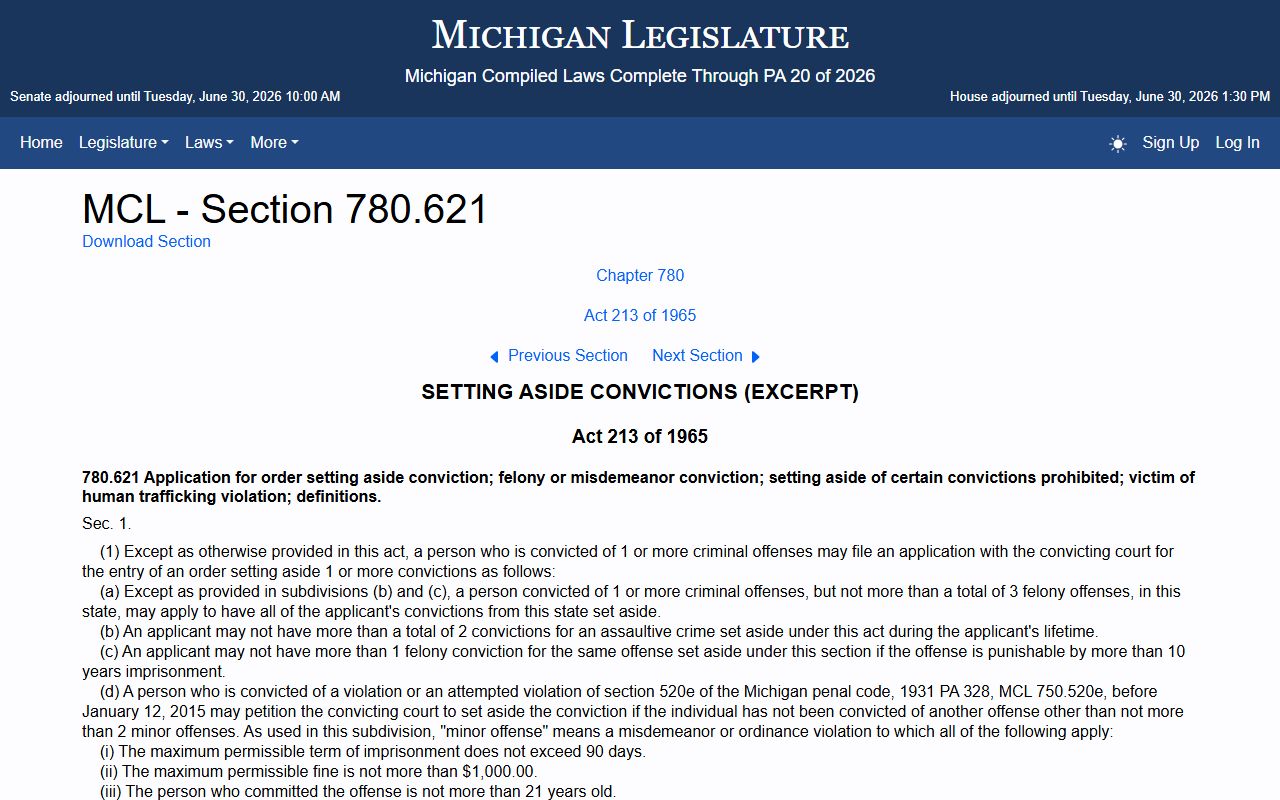
That framework governs when a conviction can be set aside and how the court order affects the public file.
Common Criminal Court Terms
Criminal files use a set of legal words that shape how a case reads. A few short definitions make the docket clearer for anyone new to the process. These terms show up in Isabella County criminal court records at nearly every stage, from the first hearing to the final order.
- Arraignment
- The first court hearing, where the charges are read and a plea is taken.
- Bind over
- The order that sends a felony from District Court up to Circuit Court for trial.
- Nolo contendere
- A no-contest plea that accepts the penalty without admitting guilt.
- Disposition
- The recorded outcome of each charge in the case.
- Bond
- Money or terms set to release a defendant while the case is open.
Public Access to Criminal Court Records
Michigan treats most court files as open records. Two frameworks control access. The Freedom of Information Act sets the public's right to inspect and copy government records, and the Michigan Court Rules govern the case files themselves. Court rules also require clerks to redact protected personal data before a file goes to public view. Open status does not promise instant, complete disclosure, since sealed and juvenile matters stay out of reach.
Key Statutes:
Michigan FOIA, MCL 15.231 - grants the public a right to inspect and copy records held by public bodies.
Michigan FOIA exemptions, MCL 15.243 - lists the categories a public body may withhold, such as certain personal data.
Background Check Considerations
A casual criminal court records lookup is not the same as a formal background check. Court search tools let anyone read public case data for personal reference. A hiring, housing, or lending decision falls under the federal Fair Credit Reporting Act, which sets accuracy and consent rules that a public search does not meet. For those uses, work through a licensed screening firm and confirm each record against the clerk's certified copy.
Important: This site is not a consumer reporting agency under the FCRA, and its records may not be used to decide credit, employment, housing, or insurance.
Restricted Criminal Court Records in Isabella County
Not every criminal file is open. Juvenile cases carry strong confidentiality under the Michigan juvenile code, MCL 712A.28, which keeps most youth records away from public search. Sealed and set-aside cases drop out of the public index by court order. Active investigations, warrants not yet served, and files with protected personal data may also be held back or redacted. When a record is missing online, the next step is a written request to the County Clerk, who can confirm whether it exists, is restricted, or must be viewed in person.
Note: A dismissed or acquitted charge can still appear in the court index unless the case is later sealed or set aside by order.